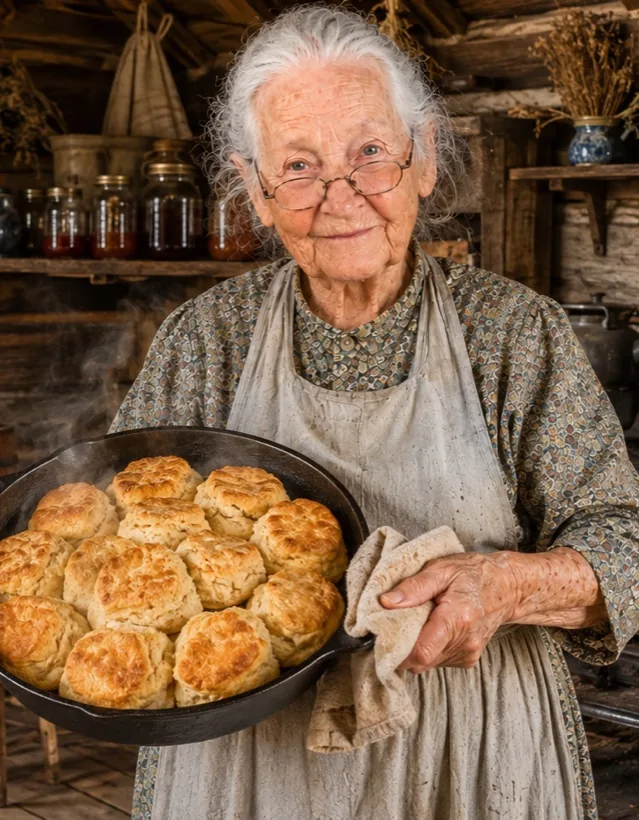
The little things she did that no recipe card ever held — the two-finger feel of the biscuit dough, the skillet screaming before the cornbread goes in, the chocolate gravy poured over it hot. That by-feel knowing was never written down, and when the last hands that hold it are gone, it's gone — unless somebody sets it down now. This is that setting-down.
You can't write down a pair of hands. But you can write down the little by-feel things beside the measured starting point — so the knowing doesn't go in the ground with the last folks who still hold it. That's what this book saves: one whole mountain kitchen, set down in the order you'd cook it, before it's gone.
My people never had two nickels to rub together, and they fed whole families like kings out of a garden, a hog, and what most folks throw away. That make-do knowing is the real inheritance in this book. That it also happens to be the cheapest good eating you'll ever do — well, that's just the way the old ways were. Here's the money part, plain, and then I'll tell you what really matters.
A pot of soup beans and a skillet of cornbread feeds you the better part of a week — right around a dollar a bowl.
Cook your suppers from the book instead of buying them out, and you keep about $216 a month — better than $2,500 a year — for right around $2 a plate. Your real number depends on how often you eat out now. Typical, not guaranteed.
But the dollars are the least of it. What you're really keeping is the knowing itself — and that doesn't come back once it's gone.
Each kitchen is a whole run of hand-skills that dies a little every year another elder goes. Set down here, in the order you'd cook them — the measured starting point first, the by-feel mastery beside it — so none of it has to be lost.
The first know-how to vanish when nobody cooks on iron anymore — saved whole.
How my people ate well with next to nothing — the knowing that carried families through.
Putting up a whole year of food, done safe — the part that has to be gotten right.
The cooking that held a whole community together, and the unwritten manners with it.
Knowing the woods well enough to eat from them — and to keep the patch alive.
The back of the book is blank receipt pages — room to set down your own grandmother's biscuit, your mawmaw's stack cake, before it goes the way all of this near about went. It's the part you hand on to somebody whose people cooked this way too, so their cooking gets saved as well. This cooking was always passed hand to hand — now it can't be lost.
Big as a cat's head, cut with a jar, by feel.
Poured hot over split biscuits. A mountain secret.
The plainest good supper there is — feeds six.
Spring's first green, in a hot iron skillet.
I was born up a branch in Letcher County, Kentucky, back before the power lines and the running water ever reached that far up the holler. I learned to cook standing at my mama's elbow, and she'd learned at her mama's before that — women born near the turn of the last century who fed whole families out of a hot iron skillet with never a measuring cup nor a written receipt between them. Nobody wrote a word of it down. You learned it by watching, and you carried it in your hands.
I married young, and I'm a widow now. I raised a passel of young'uns, kept a big garden and a milk cow and hogs and hens and bees, put up the whole winter's food every fall, and doctored my own family with yarbs and what my people taught me. But my grandchildren are grown and gone off, and they never learned a lick of it. I'm about the last one left on my creek who still knows the old ways — so I started setting them down, here, on purpose, before they go in the ground with me. That's the whole reason for the channel, and the whole reason for this book.
This book is all of it, gathered and put in order — five kitchens' worth of receipts, from the everyday skillet to the woods, each one with the measured starting point nobody ever wrote down for me, so you don't have to guess. I'm no chef and I'm no doctor. I know these things because I lived them and my people taught me — and that's the only kind of knowing a mountain kitchen ever cared about. Cook from it once, and it's yours to keep and to hand down.
It ain't a keepsake to set on a shelf. It's supper — the way she'd have made it, in your own kitchen, tonight.
Instant access — in your inbox within 60 seconds of payment. Read on any phone, tablet, or computer. Print at the kitchen table if you want. 30-day money-back guarantee, no questions asked — if it's not for you, email and the $37 comes back the same day.
$37 once — the whole book, all five kitchens, and every companion beside it. Your download link lands in your email within a minute. Read it on your phone, tablet, or computer. Pay once — no subscription, ever — and it's yours to keep and to hand down.
It comes with Opal reading every receipt aloud and a big-type edition — made for tired eyes and busy hands.
You're the one who keeps it from being lost — in your family, it goes on because of you.
More than the money, though: what you're really keeping is the knowing, before the last hands that hold it are gone.
$37 once — the whole book and every companion, no subscription, yours to keep and to hand down. Cook a few this month; if the food never feels right, one email gets a full refund, and you keep it all.
The launch promo's still on, and the knowing in these pages doesn't come back once the last hands that hold it are gone. Set it down while you can.